
Courtrooms & Catwalks: Visibility as a Mechanism of Control
-By Daphne Zhu
In temples, in markets, in courtrooms, human beings have long been drawn to witness right and wrong be judged in public view, defining crime and prescribing punishment with official order. We have built rituals around this gaze: in early 1750 BCE, ancient Mesopotamians prescribed that justice must be carried out before the city’s elders at the gates — a literal threshold where punishment was meant to be seen. In ancient Athens, trials were held in the agora, scratching a citizen’s name onto pottery shards and banishing them, using humiliation and confession as reassertions of social order. The Romans perfected this: offenders stripped of their togas or paraded through the Forum as a warning to others, their dishonor (infamia) made visible to the crowd.
Centuries later, hundreds gathered when printer John Twyn was displayed for seditious writing at the pillory at Cheapside in 1664. As historian Paul Friedland writes in Seeing Justice Done (2012), such acts were “rituals of visibility.” Even the church’s stool of shame (kyrkoplikt), described by Norbert Elias in The Civilizing Process (1939), embodied the same idea: morality required witnesses.
Across millennia, the impulse remains: the human body offered as both evidence and example.
The New York City Criminal Court at 100 Centre Street is the only court in Manhattan that stays open late for arraignments. Judges, clerks, and security pace the halls until 1:00 a.m. for night court. I sat on the chipped wooden benches near the middle, right behind some family members of defendants who were brought in one after another for arraignments and bail hearings. The cases ranged from sexual harassment to theft, hearings often lasting only minutes each.
Nothing here feels accidental: not the height of the judge’s seat raised like a miniature altar, not the placement of the rope that divides those who decide from those who wait. Here, “the eye” is embodied, and every gesture of the defendant can be scrutinized.
As each case was read out, the defendants looked back. They search into the crowd for their moms, kids or girlfriends. The family in the gallery looks back; they blow kisses and mouth I love you’s. In these moments, the individual attempts to pull back identity from the machinery of surveillance. To be recognized in a space built to strip you is a form of agency.
In the court hierarchy, another layer of surveillance is revealed: in the lower courts, cases are immediate and bodily, attorneys’ arguments about bail money and unemployment, or mental health treatment and services, expose issues at ground-level: poverty, substance use, unstable housing, immigration status. Cases in the higher courts, like the New York State Supreme Court at 60 Centre Street, often dealt with corporations, constitutional issues, or civil rights. Here, those with power are surveilled through documents, their anonymity protected by the very structures that expose the powerless.
Michel Foucault suggested that modern power operates not through violence, but through visibility. The perfect subject of the modern state is not the punished body but the observed one. Inside the courthouse, that idea finds its architecture. The space is built on a fantasy of objectivity — that if all are seen, all can be known. But the act of seeing is never neutral. To observe is already to interpret, to impose meaning. Foucault’s notion of the disciplinary society was fully alive here. Every gesture was registered and interpreted as evidence of character or risk. The courtroom, like Jeremy Bentham’s airtight penitentiary architecture of the panopticon, is structured so that to be seen is to be judged, and to be judged is to be disciplined. Even before a verdict, surveillance itself exerts punishment.
This disembodied “eye” is not simply the judge’s. It is the collective vision of the state — a gaze that no single individual owns but that everyone enforces. Jacques Lacan called it le regard, the gaze that constitutes the subject by making them aware of being seen. In this case, the defendants suspended between being themselves and being the image the court projected onto them: criminal, immigrant, addict, threat.
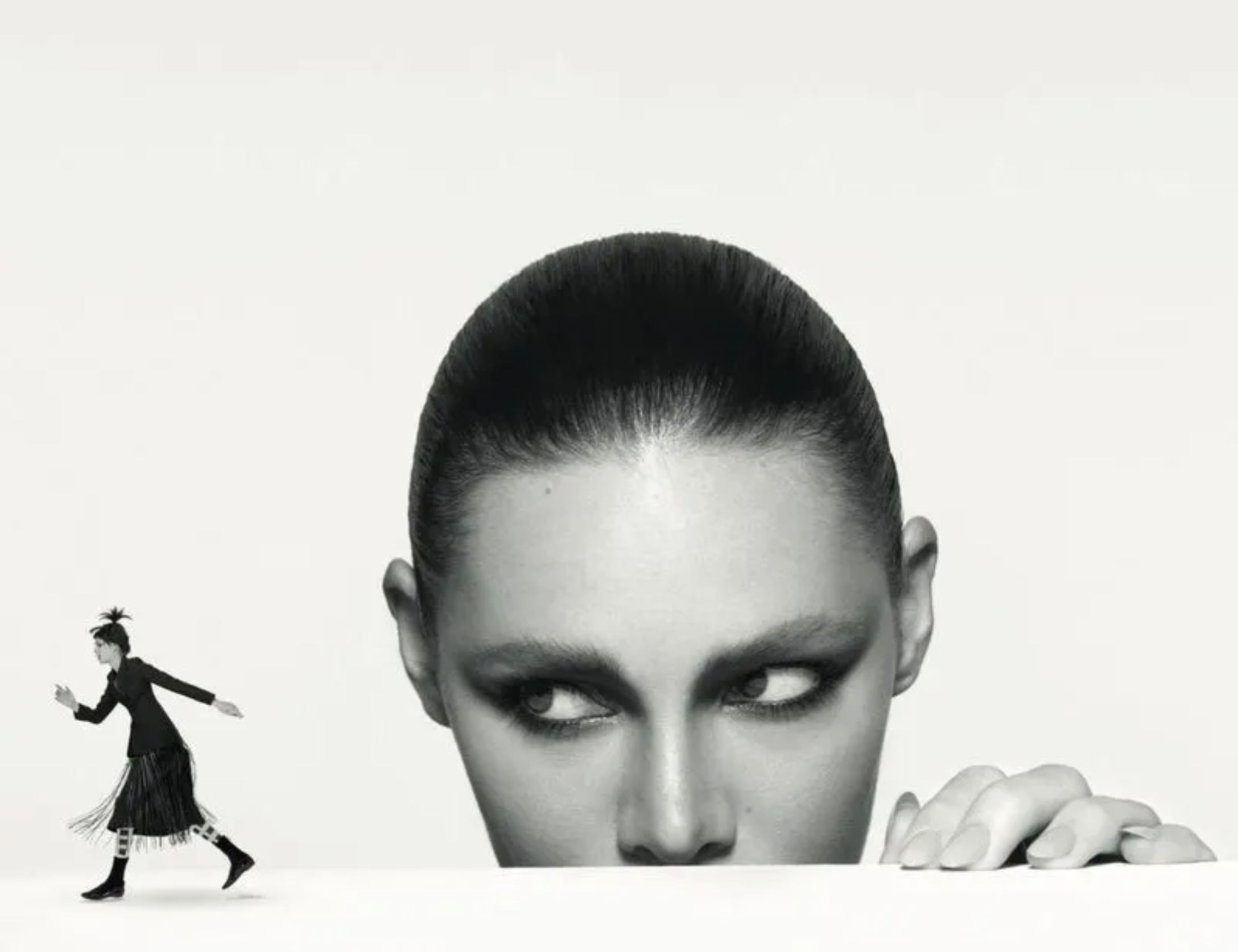
This same ritual of spectatorship echoes elsewhere, in the front row of fashion week, critics and collections are subjected to their own trials. Each season, with the appointment of new creative directors, designers present evidence of craft and vision; editors and audiences render their verdicts. The judgment of métier unfolds under flashbulbs instead of fluorescents, the judges sport bobs and blunt bangs instead of horsewigs; their black robes are Versace and tailored. The modern model marches often expressionlessly, stripped of identity beyond an ideal vessel in which garments are presented; sold, auctioned, rejected, favored.
By the mid-20th century, especially post-1960s, haute couture and editorial fashion began privileging a blank, neutral face and body — echoing fashion theorist Anne Hollander’s assertion that modern fashion treats the body as “a surface on which culture paints its meanings.” The expressionless runway model emerged to shift attention entirely to the brand, built to disappear behind the clothes they animate. And who gets the privilege of modeling these coveted, thousand-dollar pieces? High fashion’s preference for the slender, angular, almost spectral figure is not aesthetic chance but socioeconomic design — a body that signals distance from need, from labor, from hunger itself.
The runway idealizes scarcity: bodies that seem untouched by the ordinary or the accessible. To wear these garments, objects of price and gatekeeping, is to enact a hierarchy. Anthropologist Elizabeth Wissinger, in This Year’s Model (2015), notes that models are “embodied capital”— their appearance produces economic value by embodying aspirational scarcity. Sociologist Pierre Bourdieu (in Distinction, 1979) argued that the elite distinguish themselves through “aesthetic distance”, preferring what is rare, difficult, and deliberately unattainable. In Foucauldian and Bourdieusian terms, visibility becomes a disciplinary performance: the model is “perfect” not for her individuality, but for her capacity to erase herself so that fashion’s social order — its hierarchy of taste, class, and aspiration — can be made visible. The body becomes a tool, a surface for projection, becoming a conduit for the garment’s worth.
What remains, then, is the uneasy human core of the spectacle: one person standing before another, waiting to be understood. It is the same ancient impulse that once drew villagers to the edge of a fire-lit clearing to hear a verdict, now translated into the sterile fluorescence of Centre Street. The same instinct that makes our heads turn and ears perk when we hear someone else be reprimanded, the belief that we, by watching, hold the right to judge.
By the end of the night as I left the courthouse, my act of observation implicated me in the same network of surveillance I sought to analyze. To look is to participate in that negotiation; to be looked at is to risk being reduced by it.
In that sense, justice itself is a modality of surveillance: these spaces were built to stage visibility — to make justice not only done, but seen to be done. In theory, transparency of courthouses promised fairness; yet in practice, it created performance — its rituals sustained by the watchful eye of the state and the public who bear witness.